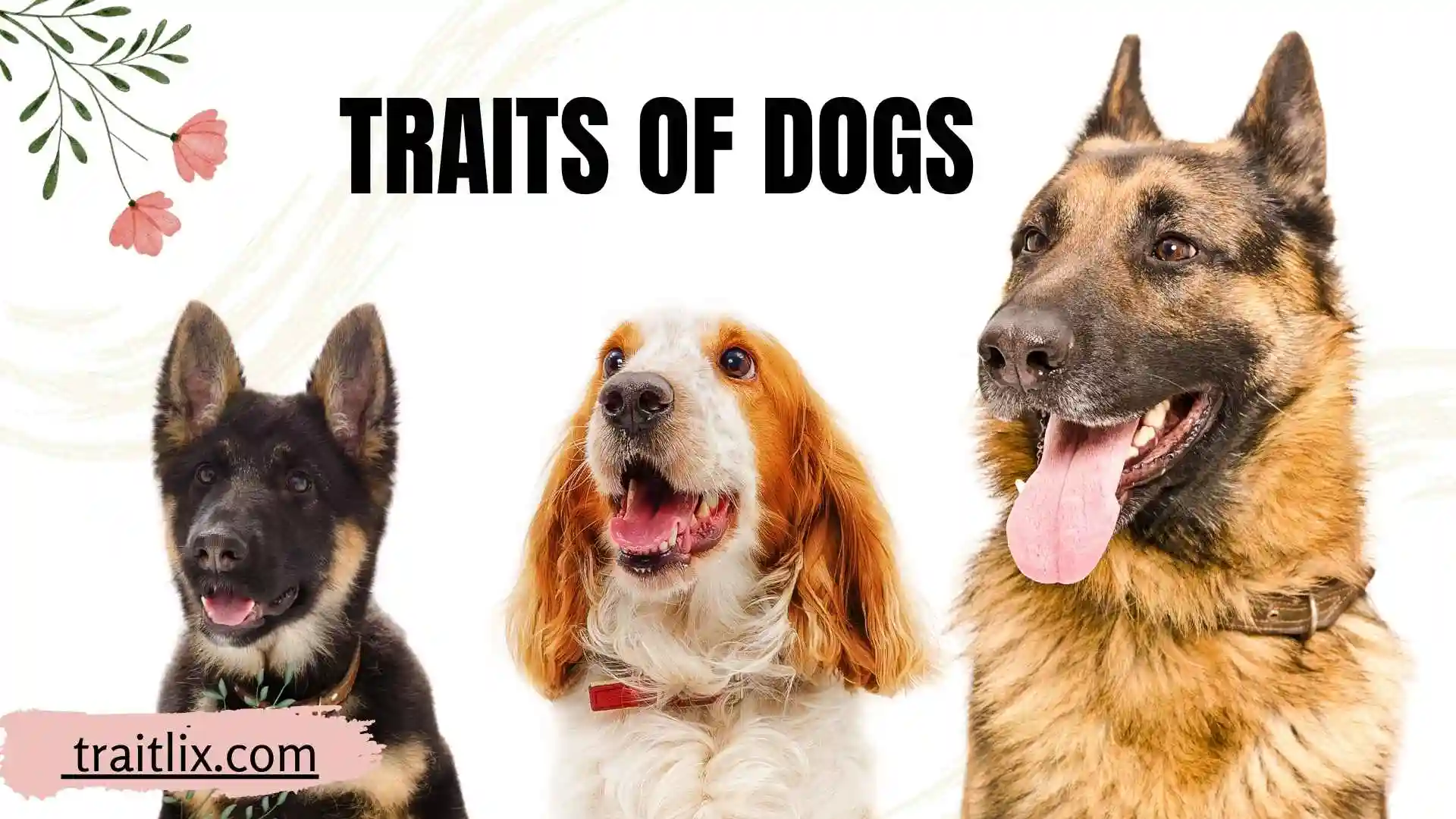
The traits of dogs include their physical features, behavior, temperament, personality, instincts, communication patterns, learning abilities, and breed-related tendencies. Dogs can be affectionate, social, playful, loyal, alert, energetic, curious, independent, cautious, or highly trainable—but no single trait describes every dog.
A dog’s traits develop through an interaction between genetics, breed history, age, early socialization, learning, environment, health, and individual experience. Research shows that breed can be strongly associated with behavioral differences, while individual dogs within the same breed can still vary substantially.
This matters because a dog should be understood as an individual, not simply as a representative of its breed. A Labrador Retriever may be friendly and eager to retrieve, for example, while another Labrador may be more reserved. Likewise, a small dog is not automatically low-energy, and a large dog is not automatically difficult to manage.
Quick Answer: What Are the Main Traits of Dogs?
Dogs commonly show traits involving appearance, temperament, behavior, social interaction, intelligence, energy, communication, instincts, and trainability.
The most important traits include:
- Affectionate: Often forms strong social bonds with people and other animals.
- Social: Many dogs actively seek interaction, companionship, and attention.
- Loyal: Can develop persistent attachment to familiar people and places.
- Playful: Many dogs retain strong play behavior throughout adulthood.
- Curious: Investigates unfamiliar smells, objects, people, and environments.
- Trainable: Dogs can learn associations, cues, routines, and behaviors through experience.
- Energetic: Activity needs vary greatly by age, individual, breed, and purpose.
- Protective or alert: Some dogs readily notice unfamiliar people, sounds, or changes around them.
- Independent: Certain dogs are more inclined to investigate or make decisions without constant human direction.
- Sensitive: Some dogs react strongly to unfamiliar environments, handling, sounds, or social pressure.
- Communicative: Dogs use posture, facial expressions, ears, tails, vocalizations, touch, and scent to communicate.
- Adaptable: Many dogs can adjust to new routines when changes are introduced appropriately.
- Instinct-driven: Breed history can influence tendencies such as retrieving, herding, scenting, chasing, guarding, or digging.
The key point is that these traits exist on spectrums. A dog can be highly social but cautious with strangers, energetic but calm indoors, or intelligent yet difficult to motivate during training.
Dog Trait Overview Table
| Trait category | What it describes | Common examples | What can influence it |
| Physical traits | Observable body characteristics | Size, coat, ears, muzzle, body shape | Genetics, breed, development |
| Temperament | Typical emotional and behavioral responses | Boldness, calmness, sensitivity | Genetics, development, experience |
| Personality | Relatively consistent individual behavioral tendencies | Sociability, curiosity, activity | Genetics, age, environment, learning |
| Social traits | How a dog interacts with people and animals | Affection, sociability, caution | Socialization, experience, genetics |
| Energy level | Need and motivation for activity | Low, moderate, high | Age, health, breed, individual variation |
| Trainability | How readily a dog learns and responds to training | Focus, responsiveness, persistence | Genetics, motivation, training |
| Instinctive traits | Behaviors linked to inherited predispositions | Herding, retrieving, scenting | Breed history and genetics |
| Communication traits | Ways dogs express information | Barking, posture, facial signals | Context, learning, emotion |
| Emotional traits | Typical responses to situations | Confidence, fearfulness, excitability | Genetics, experience, environment |
| Behavioral traits | What the dog actually does | Digging, chewing, chasing, resting | Motivation, learning, environment |
| Sensory traits | How a dog responds to sensory information | Scenting, hearing, visual attention | Biology, genetics, experience |
| Age-related traits | Changes throughout life | Puppy play, adult stability, senior slowing | Development, health, aging |
What Are Traits in Dogs?
Dog traits are relatively recognizable characteristics or tendencies that help describe how an individual dog looks, behaves, responds, learns, or interacts with its surroundings.
A useful distinction is between trait and behavior.
A behavior is something a dog does at a particular moment. A trait describes a tendency that may appear repeatedly across situations or over time.
For example:
- A dog barks when someone rings the doorbell: behavior.
- A dog frequently reacts to unfamiliar sounds: potentially a behavioral or temperament tendency.
- A dog consistently seeks interaction with familiar people: social trait.
- A dog has a dense double coat: physical trait.
- A Border Collie’s strong tendency to control movement may relate to its herding heritage: breed-associated behavioral tendency.
Scientific research often treats animal personality as relatively consistent behavioral differences between individuals over time and across contexts. However, consistency does not mean a dog’s behavior is fixed forever.
The Major Types of Dog Traits
Physical Traits
Physical traits are the characteristics you can observe in a dog’s body.
They include:
- Body size
- Height
- Weight range
- Skull and muzzle shape
- Ear shape
- Tail structure
- Leg length
- Body proportions
- Coat length
- Coat texture
- Coat color and pattern
- Eye color
- Muscle development
- Paw structure
Physical traits are strongly influenced by genetics and breed history. Selective breeding has produced enormous variation among domestic dogs, from tiny companion breeds to large working dogs.
Physical appearance can also provide clues about a dog’s historical function. A dog bred for endurance, swimming, scenting, retrieving, herding, or guarding may possess physical characteristics that supported that role.
However, appearance does not reliably tell you everything about temperament.
A muscular dog is not necessarily aggressive. A fluffy dog is not necessarily gentle. A small dog is not necessarily quiet.
Temperament Traits
Temperament describes relatively stable tendencies in how a dog responds emotionally and behaviorally to situations.
Common temperament dimensions include:
- Boldness
- Caution
- Sociability
- Emotional reactivity
- Calmness
- Excitability
- Persistence
- Adaptability
- Sensitivity
- Confidence
Two dogs can encounter the same situation and respond differently.
Imagine two dogs hearing a vacuum cleaner:
Dog A investigates it, sniffs it, and quickly returns to normal.
Dog B moves away, watches carefully, and needs more time to relax.
Neither response automatically means the dog is “good” or “bad.” They reveal differences in temperament and experience.
Research involving thousands of dogs has found associations between breed, age, social environment, and personality traits, while also emphasizing that these factors explain only part of the variation between individual dogs.
Personality Traits
Personality is broader than a single behavior. It refers to relatively consistent patterns in how an individual dog responds to people, animals, objects, and situations.
A dog’s personality may include combinations such as:
- Friendly and energetic
- Calm and independent
- Curious and bold
- Affectionate and sensitive
- Playful and persistent
- Cautious and observant
- Social and highly excitable
Personality should not be confused with a permanent label.
A dog described as “shy” may become more confident with carefully managed experiences. A highly excitable puppy may become calmer with maturity and appropriate training.
Social Traits
Dogs are highly social animals and communicate with humans and other dogs through body posture, facial expressions, tail and ear positions, vocalizations, touch, and scent.
Social traits may include:
- Sociability with people
- Interest in other dogs
- Attachment to caregivers
- Desire for physical contact
- Social confidence
- Stranger tolerance
- Playfulness
- Ability to settle around others
Importantly, being social does not mean wanting to greet everyone.
A well-adjusted dog may calmly ignore unfamiliar people rather than enthusiastically approach them. Neutrality can be a useful social behavior.
Energy and Activity Traits
Energy level is one of the most misunderstood traits in dogs.
Activity needs can differ according to:
- Breed or lineage
- Age
- Health
- Individual personality
- Training
- Environment
- Daily routine
- Work or enrichment opportunities
A small terrier can require substantial mental and physical activity, while a much larger dog may be relatively relaxed.
Even within the same breed, individuals can have different activity levels.
This is why choosing a dog based only on size can lead to poor matches.
Trainability and Learning Traits
Trainability refers broadly to how readily a dog learns and performs behaviors in response to cues, reinforcement, environmental conditions, and motivation.
Trainability can involve:
- Attention
- Motivation
- Persistence
- Responsiveness to human cues
- Ability to repeat learned behaviors
- Tolerance for distractions
- Speed of acquiring new associations
A dog that is difficult to train is not necessarily unintelligent.
For example, a scent-driven dog may appear distracted during obedience practice because following a scent is more rewarding in that moment. A highly independent dog may understand a cue perfectly but require a stronger reason to perform it.
Good training therefore considers motivation and the dog’s natural behavioral tendencies, rather than treating obedience as a simple intelligence test.
Instinctive Traits
Dogs retain behavioral tendencies shaped by generations of selective breeding.
Depending on their ancestry and purpose, dogs may show stronger tendencies toward:
- Herding
- Retrieving
- Tracking
- Scenting
- Chasing
- Pointing
- Guarding
- Digging
- Pulling
- Running
- Following trails
- Carrying objects
- Watching movement
Humans historically selected dogs for particular jobs, and modern breeds still reflect some of those functional histories. Research has also found genetic contributions to differences in behavior among dog breeds.
This explains why the question “Why does my dog do this?” sometimes has an answer connected to what the dog’s ancestors were bred to do.
Positive Traits Commonly Seen in Dogs
Dogs can display many traits people value in companions, working animals, and assistance roles.
Affectionate
Many dogs form strong bonds with familiar humans.
Affection may appear as:
- Following a person from room to room
- Resting nearby
- Seeking gentle contact
- Greeting familiar people
- Bringing toys
- Choosing to sleep close to caregivers
Affection varies between individual dogs. A dog that does not enjoy prolonged cuddling may still have a strong attachment to its caregiver.
Loyal and Attached
Dogs often develop stable relationships with familiar people.
Attachment may be expressed through proximity, greeting behavior, attention to a caregiver’s movements, or preference for familiar social partners.
“Unconditional loyalty” is a popular phrase, but scientifically it is more useful to discuss social attachment, familiarity, reinforcement, and learned relationships rather than assuming dogs experience loyalty exactly as humans conceptualize it.
Playful
Play is particularly obvious in puppies but remains important for many adult dogs.
Play can include:
- Chasing
- Tugging
- Fetching
- Wrestling
- Toy manipulation
- Play bows
- Social games
Play also provides opportunities for physical movement, exploration, and social interaction.
Curious
Curiosity encourages dogs to investigate:
- New smells
- Sounds
- Objects
- People
- Environments
- Food-related cues
Curiosity can make dogs excellent explorers, but it can also create management challenges when a dog investigates unsafe objects or wanders into restricted areas.
Adaptable
Some dogs adjust quickly to new routines, environments, or people.
Others need more gradual introductions.
Adaptability is not simply a question of obedience. A dog may know how to behave but still need time to become emotionally comfortable in an unfamiliar setting.
Alert
Many dogs are attentive to changes in their surroundings.
They may notice:
- A person approaching the house
- A strange sound
- A new smell
- Movement outside
- Changes in household routines
Alertness can be useful, but excessive reactivity can become stressful for both the dog and the household.
Protective or Watchful
Some dogs show strong guarding or watchful tendencies.
However, “protective” should not automatically be interpreted as desirable aggression.
A healthy companion dog should be able to remain under control and respond appropriately to its environment. Uncontrolled defensive behavior can create safety risks.
Traits That Can Become Challenging
Not every undesirable behavior represents a bad personality trait.
A behavior can be normal for a dog but problematic in a particular household.
Excessive Barking
Barking can serve many functions:
- Alerting
- Soliciting attention
- Excitement
- Frustration
- Fear
- Social communication
- Response to environmental stimulation
The useful question is not simply, “How do I stop my dog barking?”
Ask:
What is causing the barking, and what does the dog gain or avoid by doing it?
Understanding the function makes behavior modification more effective.
Fearfulness
Fear can appear as:
- Hiding
- Avoidance
- Freezing
- Trembling
- Lowered posture
- Attempts to escape
- Defensive responses
Fear should not be treated as stubbornness.
Early socialization and appropriate exposure to people, animals, environments, and experiences can influence later behavior. Veterinary guidance notes that inadequate exposure during important developmental periods can increase the risk of fearful behavior.
Reactivity
A reactive dog may respond intensely to particular triggers such as:
- Other dogs
- Strangers
- Cars
- Bicycles
- Sounds
- Handling
- Specific environments
Reactivity can have different causes, including fear, frustration, excitement, learned associations, or combinations of these factors.
Destructive Chewing
Chewing is normal canine behavior.
Problems arise when dogs chew:
- Furniture
- Electrical cables
- Shoes
- Doors
- Household objects
Instead of assuming the dog is “bad,” consider whether it lacks appropriate outlets, enrichment, supervision, exercise, or access to suitable chew items.
Digging
Digging can be related to:
- Exploration
- Instinct
- Seeking cooler ground
- Burying objects
- Escape attempts
- Boredom
- Chasing underground animals
Providing an appropriate digging area can sometimes redirect the behavior more effectively than simply punishing it.
Chasing
Chasing can be strongly rewarding for some dogs.
Movement from:
- Squirrels
- Cats
- Birds
- Joggers
- Bicycles
- Cars
can trigger pursuit.
This is particularly important for dogs with strong prey-drive or working-line tendencies.
How Genetics Shape Dog Traits
Genetics matter, but genes do not create a simple script that determines everything a dog will do.
Research supports a genetic component to canine personality and behavior. One study of Labrador Retrievers found genetic variance for several personality traits, including fetching tendency and fear of loud noises, while other traits showed much smaller heritability.
Another large study examining more than 14,000 dogs from 101 breeds found substantial among-breed genetic contributions for multiple behavioral traits.
The important lesson is:
Genetic influence is not the same as genetic destiny.
A dog’s behavioral outcome results from an interaction among:
Genes + development + socialization + learning + environment + health + individual experience
That is why puppies from the same litter can develop noticeably different personalities.
Breed History Matters
Breeds were developed for different functions.
The American Kennel Club groups recognized breeds into categories including Sporting, Hound, Working, Terrier, Toy, Non-Sporting, and Herding. These groupings reflect function and heritage.
For example:
| Breed function | Traits that may be relevant |
| Herding | Responsiveness, movement sensitivity, persistence |
| Retrieving | Object interest, cooperation, carrying behavior |
| Scent hounding | Scent motivation, persistence, independence |
| Terrier work | Persistence, alertness, prey-oriented behavior |
| Guarding | Watchfulness, confidence, environmental awareness |
| Companion work | Human orientation, sociability, adaptability |
| Sighthound work | Visual attention, speed, pursuit tendencies |
| Draft or working roles | Physical endurance, strength, persistence |
These are general tendencies, not guarantees.
How Environment and Socialization Affect Dog Traits
A dog’s genes are only part of the picture.
Environment includes:
- Early puppy experiences
- Human handling
- Exposure to different environments
- Household routine
- Training
- Reinforcement
- Exercise
- Mental enrichment
- Relationships with people
- Experiences with other animals
- Stress
- Physical health
Merck Veterinary Manual describes canine behavior as influenced by genetic predisposition, experience, learning, environment, physiology, and developmental factors.
A 2023 study of more than 11,000 dogs similarly found that breed and age had strong associations with personality, while puppyhood socialization was an important environmental factor. The study also emphasized that these variables explain only part of individual variation.
Why Puppyhood Matters
Puppies go through important developmental stages during which experiences can influence later responses.
Early experiences should be:
- Safe
- Gradual
- Positive
- Appropriate for the puppy
- Free from overwhelming pressure
Socialization does not mean forcing a puppy to greet everyone.
A better definition is helping a puppy learn that a wide range of ordinary people, animals, environments, surfaces, sounds, and experiences can be safe and manageable.
Dog Traits by Breed Group
Breed groups can help predict tendencies, but they should never replace observation of the individual dog.
Sporting Dogs
Sporting breeds were historically developed for hunting-related tasks such as locating, pointing, flushing, or retrieving.
Common tendencies can include:
- High engagement with people
- Activity
- Retrieving interest
- Responsiveness
- Enthusiasm
- Endurance
Hounds
Hounds include scent-oriented and sight-oriented types.
Potential tendencies include:
- Strong scent or visual motivation
- Persistence
- Independence
- Chase behavior
- Environmental focus
A hound that appears “selectively obedient” may be responding to a highly rewarding scent or visual stimulus.
Herding Dogs
Herding dogs were selected to work with livestock and often show strong responsiveness to movement.
Potential traits include:
- Alertness
- High activity
- Quick responses
- Trainability
- Persistence
- Movement sensitivity
Without suitable outlets, some herding dogs may invent their own activities.
Terriers
Many terriers were developed for controlling vermin and other forms of close-range work.
Potential traits include:
- Boldness
- Persistence
- High engagement
- Digging
- Chasing
- Vocal behavior
Their determination can be valuable in work and sports but challenging in a low-stimulation household.
Working Dogs
Working breeds were developed for varied jobs, including guarding, pulling, rescue, and other forms of physical or cooperative work.
Potential traits vary widely, but many were selected for:
- Strength
- Endurance
- Confidence
- Environmental awareness
- Cooperation
- Physical capability
Toy Dogs
Toy breeds were primarily developed as companion animals, although their ancestors and individual breeds have diverse histories.
Commonly associated traits can include:
- Human orientation
- Alertness
- Sociability
- Adaptability to indoor life
Small size does not automatically mean low energy or low training needs.
Non-Sporting Dogs
This is a diverse category containing breeds with very different histories and characteristics.
Because of that diversity, it is difficult to assign one personality pattern to the entire group.
Dog Traits by Age
Dog behavior changes throughout life.
| Life stage | Traits you may notice |
| Puppy | Exploration, play, rapid learning, chewing, social development |
| Adolescence | Increased independence, excitement, testing boundaries, changing social behavior |
| Adult | More established routines and behavioral patterns |
| Senior | Potentially lower activity, increased need for comfort, sensory changes, altered routines |
Age does not automatically determine personality.
A senior dog may remain playful, while a young dog may be unusually calm.
Sudden changes in behavior, especially in an older dog, deserve attention because pain, illness, sensory changes, or other physical factors can affect behavior. Veterinary behavioral medicine emphasizes the connection between physical health, welfare, and behavior.
How to Read Dog Traits Through Body Language
A dog’s body language provides context, but individual signals should not be interpreted in isolation.
Relaxed Dog
A relaxed dog may show:
- Loose body posture
- Comfortable movement
- Natural ear position
- Soft facial expression
- Normal breathing
- Willingness to disengage
Excited Dog
Excitement may involve:
- Faster movement
- Increased attention
- Tail movement
- Play behavior
- Vocalization
- Jumping or pacing
Excitement is not always the same as happiness.
Fearful or Uncomfortable Dog
Possible signs include:
- Avoidance
- Lowered body
- Turning away
- Lip licking
- Freezing
- Hiding
- Trembling
- Attempts to create distance
Context matters.
A single lip lick, for example, does not prove fear. A pattern of signals combined with the surrounding situation is more informative.
Aggressive or Defensive Behavior
Warning signs can include:
- Stiff posture
- Intense staring
- Growling
- Snapping
- Lunging
- Baring teeth
- Attempts to increase distance
These behaviors should be taken seriously.
Punishment can suppress visible warning signals without addressing the underlying emotional response. For serious aggression, fear, or sudden behavioral changes, professional veterinary or qualified behavior support is appropriate.
Personality Traits vs. Behavior
| Personality trait | Behavior |
| Relatively consistent tendency | Observable action in a specific situation |
| Can appear across contexts | Often strongly context-dependent |
| Develops through multiple influences | Can be learned or triggered |
| Example: generally cautious | Example: backs away from a stranger |
| Broader pattern | Specific event or response |
A single incident should not be used to define a dog’s entire personality.
For example, a dog that growls once when startled should not automatically be labeled an “aggressive dog.” Context, frequency, triggers, history, health, and body language all matter.
Breed Traits vs. Individual Traits
| Breed-associated tendency | Individual trait |
| Reflects population-level patterns | Describes one particular dog |
| Influenced by selective breeding | Influenced by genetics and individual experience |
| Useful for predicting possibilities | More useful for understanding the dog in front of you |
| Does not guarantee behavior | Still not completely fixed |
| Can guide breed selection | Should guide day-to-day management |
Merck Veterinary Manual specifically cautions that breed stereotyping can produce inaccurate assessments because substantial behavioral variation exists within breeds as well as between breeds.
Nature vs. Nurture in Dogs
The better question is not whether traits come from nature or nurture.
They come from both.
Consider three puppies:
- Puppy A inherits strong retrieving tendencies and receives regular retrieving opportunities.
- Puppy B has similar ancestry but receives little opportunity to retrieve.
- Puppy C has retrieving tendencies but becomes highly focused on another activity through its environment and reinforcement history.
Their genetics may create different starting tendencies, but experience influences how those tendencies are expressed.
This is one reason behavioral traits are best understood as gene-environment interactions rather than simple inherited labels.
15 Real-Life Examples of Dog Traits
1. The Doorbell Watcher
A dog immediately moves toward the door when the bell rings.
This may demonstrate alertness and learned anticipation rather than aggression.
2. The Shadow Dog
A dog follows its caregiver around the house.
This may reflect social attachment, habit, reinforcement, or a preference for companionship.
3. The Independent Explorer
A dog spends time sniffing and investigating rather than constantly checking in with its owner.
This may reflect environmental motivation or independence.
4. The Fetch Enthusiast
A dog repeatedly brings a ball back after it is thrown.
This can reflect both individual preference and retrieving-related tendencies.
5. The Herding-Inclined Dog
A dog attempts to control the movement of children, pets, or running people.
This may reflect movement sensitivity and herding-related behavioral tendencies.
6. The Scent Detective
A dog stops repeatedly during walks to investigate smells.
For a scent-oriented dog, sniffing is not simply distraction. It can be a highly rewarding form of environmental information gathering.
7. The Cautious Puppy
A puppy hesitates around a new object.
Instead of forcing interaction, the caregiver allows the puppy to observe from a comfortable distance and gradually approach.
This supports confidence-building.
8. The Apartment Athlete
A small dog appears calm indoors but becomes intensely energetic outside.
This shows why body size alone is a poor measure of activity needs.
9. The Social Butterfly
A dog enjoys meeting familiar people and playing with suitable dogs.
Its strong sociability may make it thrive in environments with appropriate social opportunities.
10. The Quiet Observer
A dog rarely approaches strangers but calmly watches them.
This does not necessarily indicate a problem. Some dogs prefer neutrality over direct social interaction.
11. The Persistent Chewer
A young dog repeatedly chews furniture.
Rather than interpreting this as revenge, the owner examines access to appropriate chewing outlets, supervision, enrichment, and routine.
12. The Sound-Sensitive Dog
A dog reacts strongly to fireworks or thunderstorms.
Fear of loud noises is a recognized behavioral trait with genetic and environmental components.
13. The Guarding Dog
A dog becomes alert when an unfamiliar person approaches the home.
This may involve territorial behavior, environmental awareness, learned associations, or breed-related tendencies.
14. The Food Motivated Learner
A dog rapidly learns behaviors when food rewards are used.
This demonstrates strong motivation in that training context—not necessarily greater intelligence than every dog that prefers toys or praise.
15. The Senior Routine Keeper
An older dog becomes less interested in long walks but remains strongly attached to familiar daily routines.
This illustrates how aging can alter activity without eliminating personality.
How to Identify Your Dog’s Dominant Traits
Instead of assigning a label after one event, observe patterns.
Step 1: Observe Across Different Situations
Watch your dog:
- At home
- Outdoors
- Around familiar people
- Around strangers
- Around other dogs
- During play
- During rest
- During training
- In unfamiliar environments
Step 2: Record Repeated Patterns
Ask:
- What reliably excites my dog?
- What causes hesitation?
- What motivates my dog?
- Does my dog recover quickly after stress?
- Does my dog seek people or prefer space?
- Does my dog explore independently?
- What activities does my dog choose?
Step 3: Separate Triggers From Traits
If your dog reacts to bicycles, do not immediately conclude that the dog is generally aggressive.
Identify:
Trigger → emotional response → behavior → consequence
For example:
Bicycle appears → dog becomes excited → dog lunges → bicycle moves away
That pattern provides much more useful information than the label “aggressive.”
Step 4: Consider Health
Pain and illness can change behavior.
If a normally friendly dog suddenly becomes irritable, withdrawn, unusually vocal, or resistant to handling, a veterinary assessment may be appropriate.
Step 5: Look for Motivation
Ask what your dog wants.
Possible motivations include:
- Food
- Play
- Social interaction
- Escape
- Access to another animal
- Exploration
- Comfort
- Attention
- Chasing
- Scent investigation
Understanding motivation makes training and management more practical.
A Simple Decision Guide for Understanding Dog Behavior
Does the behavior happen repeatedly?
↓ No
Treat it as a single event and consider the immediate context.
↓ Yes
Does it happen only around a particular trigger?
↓ Yes
Investigate the trigger, emotional response, and consequences.
↓ No
Does it occur across many situations?
↓ Yes
It may reflect a broader temperament or personality tendency.
Has the behavior changed suddenly?
↓ Yes
Consider health, pain, environmental changes, aging, stress, or a new learning history. Veterinary advice may be appropriate.
Is the behavior creating a safety risk?
↓ Yes
Prioritize management and seek qualified veterinary behavior or professional behavior support.
Common Misconceptions About Dog Traits
Myth: Every Dog of the Same Breed Has the Same Personality
Fact: Breed can influence behavioral tendencies, but individual variation within breeds is substantial.
Myth: Small Dogs Need Little Exercise
Fact: Size does not determine activity needs. Some small working or terrier-type dogs can be highly active.
Myth: A Wagging Tail Always Means a Dog Is Happy
Fact: Tail movement is context-dependent. Excitement, arousal, uncertainty, and social communication can all involve tail movement.
Myth: A Growling Dog Is Always Aggressive
Fact: Growling is a form of communication. It can occur with fear, discomfort, guarding, frustration, or other emotional states.
Myth: A Calm Dog Is Always Well Trained
Fact: Calmness may reflect temperament, age, fatigue, environment, health, or learning. Training and temperament are not the same thing.
Myth: A Highly Trainable Dog Is Automatically More Intelligent
Fact: Training performance depends on motivation, attention, reinforcement, environment, relationship, and the task itself.
Myth: Genetics Completely Determine a Dog’s Personality
Fact: Genetics influence behavior, but environmental factors, learning, development, and experience also contribute substantially.
Myth: Socialization Means Meeting as Many Dogs as Possible
Fact: Good socialization involves positive, appropriate exposure to many aspects of the world. Forced interactions can be counterproductive.
Myth: Punishment Is the Best Way to Eliminate an Unwanted Trait
Fact: Behavior problems often require understanding the underlying motivation and changing the environment, reinforcement history, or emotional response. Veterinary behavior guidance recommends humane approaches and early positive reinforcement training.
How to Encourage Healthy Behavioral Traits
A dog’s personality should not be forced into a particular mold. Instead, owners can create conditions that allow desirable behaviors to develop and become reliable.
Provide Appropriate Exercise
Exercise should match the dog’s age, health, physical ability, and individual needs.
Options can include:
- Walking
- Hiking
- Fetch
- Swimming where appropriate
- Structured play
- Canine sports
- Controlled running
- Scent activities
Provide Mental Enrichment
Mental stimulation can include:
- Food puzzles
- Scent games
- Training sessions
- Search games
- Novel but safe environments
- Appropriate chew items
- Problem-solving activities
Mental enrichment is especially useful for dogs whose behavioral needs are not fully satisfied by physical exercise alone.
Use Reward-Based Training
Reward-based training can make learning clearer and provide dogs with motivation to repeat desirable behaviors.
Rewards may include:
- Food
- Toys
- Play
- Access to something the dog wants
- Praise or social interaction
The most effective reward depends on the individual dog.
Respect Individual Differences
One dog may love:
- Crowded dog parks
- Constant play
- Meeting strangers
Another may prefer:
- Quiet walks
- Familiar people
- Sniffing
- Resting nearby
A successful relationship does not require every dog to behave the same way.
Traits to Consider When Choosing a Dog
If you are selecting a dog for your household, look beyond appearance.
Consider:
- Energy level
- Adult size
- Grooming needs
- Exercise requirements
- Trainability
- Vocal tendencies
- Social preferences
- Independence
- Breed-related instincts
- Living environment
- Time available for training
- Experience with dogs
- Compatibility with children or other pets
- Potential health considerations
- The individual dog’s observed temperament
Match the Dog to Your Lifestyle
A better question than “Which dog is cutest?” is:
Which dog’s natural tendencies fit the life I can realistically provide?
For example:
| Lifestyle | Traits to consider |
| Active runner | Endurance, activity needs, physical suitability |
| Quiet apartment | Ability to settle, manageable exercise needs, vocal tendencies |
| Rural home | Exploration, recall training, prey or livestock considerations |
| Family household | Social flexibility, appropriate temperament, supervision needs |
| First-time owner | Trainability, manageable behavioral needs, support availability |
| Experienced trainer | Higher-drive or independent dogs may be manageable with suitable outlets |
No breed is automatically the “best dog.” Compatibility matters more than popularity.
Related Dog Traits to Explore
Understanding one trait often leads to another.
Useful related concepts include:
- Dog temperament
- Dog personality
- Dog behavior
- Dog body language
- Dog socialization
- Dog intelligence
- Dog trainability
- Dog energy levels
- Dog instincts
- Dog prey drive
- Dog herding behavior
- Dog communication
- Puppy development
- Canine learning
- Breed-specific behavior
- Canine enrichment
- Dog anxiety
- Dog fear
- Dog aggression
- Dog attachment
- Dog behavior problems
These concepts are connected rather than isolated. For example, a dog’s prey drive can affect chasing behavior, which can affect recall training, which can affect off-leash management.
Frequently Asked Questions
What are the main traits of dogs?
The main traits of dogs include physical characteristics, sociability, affection, curiosity, playfulness, energy, trainability, adaptability, confidence, sensitivity, communication ability, and instinctive behaviors such as retrieving, herding, scenting, guarding, or chasing.
What are positive traits of dogs?
Commonly valued traits include affection, sociability, loyalty, curiosity, adaptability, playfulness, responsiveness, confidence, persistence, and willingness to cooperate. The usefulness of a trait depends on the dog’s environment and purpose.
What are the personality traits of dogs?
Dog personality can include sociability, activity level, boldness, fearfulness, excitability, persistence, independence, and responsiveness. These characteristics vary between individuals and can be influenced by genetics, age, environment, socialization, and experience.
Are dog traits inherited?
Some dog traits have genetic components, including certain behavioral and personality tendencies. However, most complex behavioral traits are influenced by multiple genetic and environmental factors rather than a single gene.
Do all dogs of the same breed have the same traits?
No. Breed can provide useful information about likely tendencies, but individual dogs can differ considerably. Environment, socialization, learning, age, health, and individual genetics all contribute to behavior.
Are small dogs less active than large dogs?
Not necessarily. Activity needs are influenced by breed history, age, health, and individual temperament. Some small dogs have very high activity and mental stimulation needs.
What traits make a dog easy to train?
Dogs that are attentive, motivated, responsive to reinforcement, and able to work around manageable distractions may be easier to train. However, trainability is not identical to intelligence.
What is the difference between dog temperament and personality?
Temperament generally refers to relatively stable emotional and behavioral tendencies, while personality is a broader description of consistent individual patterns. The terms overlap in everyday use.
Can a dog’s personality change?
Yes. Although some tendencies can remain relatively stable, behavior can change with maturation, learning, socialization, environment, health, and life experiences.
Why does my dog act differently around different people?
Dogs respond to differences in familiarity, body language, movement, voice, scent, previous experiences, reinforcement history, and context. A dog may be relaxed with family members but cautious around strangers without having a generally “bad” personality.
Why do some dogs chase cars, bicycles, or animals?
Chasing can be motivated by movement sensitivity, prey-related behavior, excitement, frustration, learned reinforcement, or other factors. Because road chasing can be dangerous, management and appropriate training are important.
Can you tell a dog’s personality from appearance?
Only to a limited degree. Physical features can provide information about breed history and potential functional tendencies, but appearance alone cannot reliably predict an individual dog’s personality.
What traits should I look for in a family dog?
Look for an individual dog whose activity level, social behavior, tolerance for handling, adaptability, and training needs fit the household. Breed history can provide useful background, but the individual dog’s observed behavior is equally important.
What should I do if my dog’s behavior suddenly changes?
Consider whether there has been a change in routine, environment, social relationships, or learning history. Because pain and illness can also alter behavior, a sudden or significant change should be discussed with a veterinarian, especially when accompanied by other physical or behavioral symptoms.
Key Takeaways
- Traits of dogs include physical, behavioral, emotional, social, instinctive, and personality characteristics.
- Dog personality is not determined by breed alone.
- Genetics influence many traits, but they interact with learning, environment, socialization, development, and experience.
- Breed history can help explain tendencies such as retrieving, herding, scenting, chasing, guarding, or digging.
- Individual dogs within the same breed can behave very differently.
- Size is a poor substitute for assessing activity level.
- A behavior should be interpreted in context rather than used to assign an immediate personality label.
- Body language can reveal information about a dog’s emotional state, but individual signals should not be interpreted in isolation.
- Positive reinforcement and appropriate enrichment can support desirable behavior.
- Sudden behavioral changes may have medical or environmental causes and should not automatically be treated as a training problem.
- The best dog for a household is one whose traits and needs are compatible with the owner’s lifestyle.
- Understanding why a dog behaves a certain way is usually more useful than simply labeling the behavior.
Conclusion
The traits of dogs are remarkably diverse. Dogs can be affectionate, playful, curious, energetic, independent, sensitive, confident, cautious, alert, persistent, social, or highly motivated by particular activities. Their physical and behavioral characteristics reflect a combination of genetics, breed history, development, socialization, learning, environment, health, and individual experience.
The most important lesson is to avoid treating breed descriptions as guarantees. Scientific evidence shows meaningful genetic contributions to canine behavior, but it also demonstrates substantial individual variation and environmental influence.
A dog is more than its breed label. The most accurate understanding comes from observing the individual: what motivates the dog, what causes stress, how quickly it recovers, how it communicates, what activities it enjoys, and how its behavior changes across different situations.

I am Freya Caldwell, a curious writer fascinated by the unique qualities that make every person different. I explore personality traits, emotional characteristics, strengths, and weaknesses in simple language. My goal is to help readers better understand human behaviour and discover meaningful insights that support personal awareness and growth.
Books:
- A Simple Guide to Human Traits
- Discover the Qualities Within You